
Self-Portrait as Pink Acolyte, woodcut on Korean paper, 1940
One of her few surviving self-portraits, this image shows Riesenbaum in her prime as she was approximately 14 years into her tenure as Pink Acolyte.
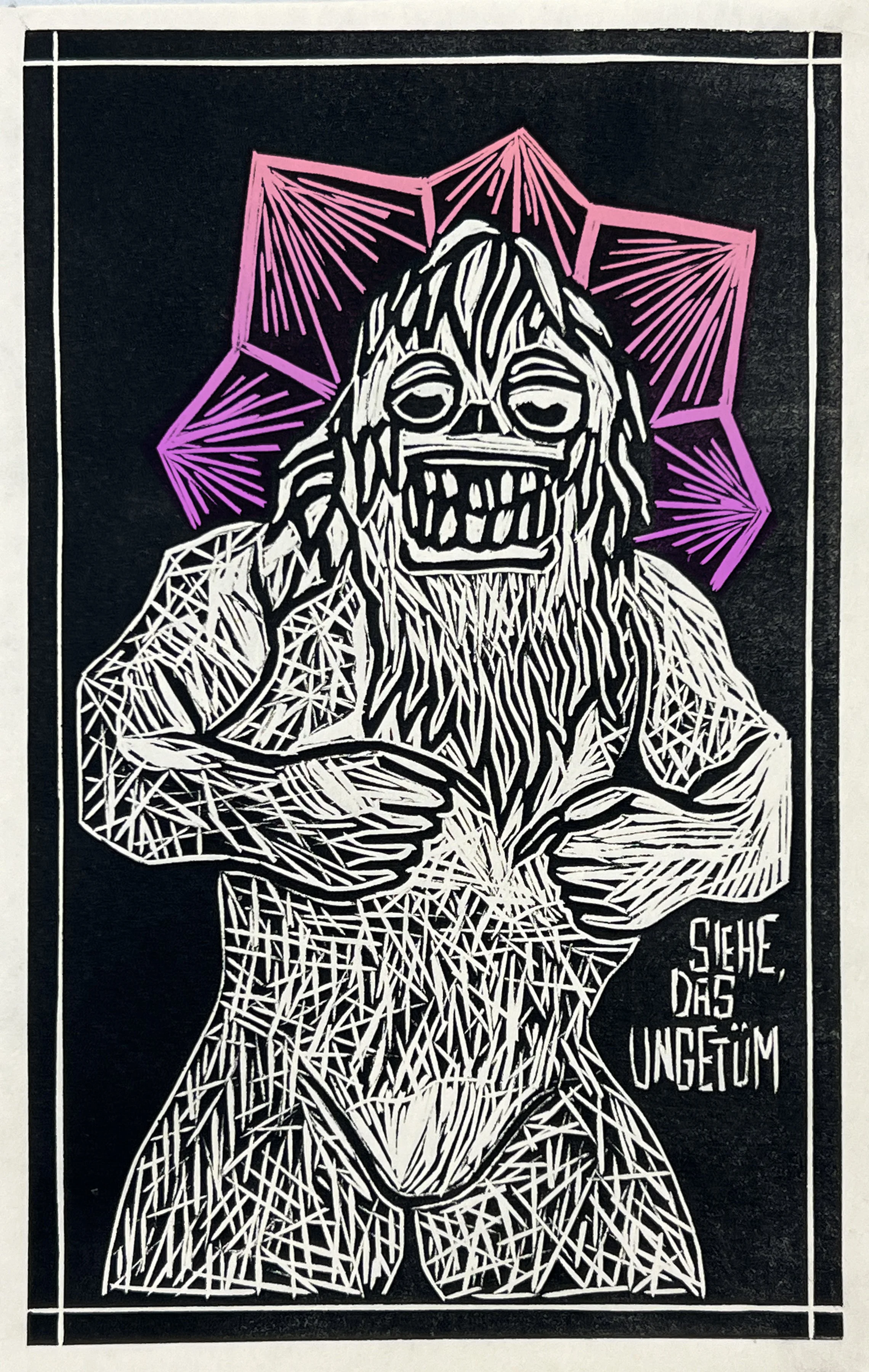
Siehe, Das Ungetüm, relief print on Korean paper, c. 1943
Johanna Riesenbaum: 1905-1956
Pink Acolyte Service: 1926-1950
Johanna Riesenbaum was born in 1905 in Mount Healthy, Ohio. Not much is known about her early life as she seemingly never kept a journal or engaged in any kind of writing. Research indicates her father died when she was young and as such she grew up as the middle daughter of a single mother in a family of brothers. In the spring of 1925, she met Marco di Gatti, who took to her as a mentor and father figure. Shortly after his death in 1926, she and di Gatti’s close circle formally established their group as the Pink Acolyte Union, inheriting the title in the process. Riesenbaum’s portfolio consists primarily of woodcut and drypoint prints, combining German expressionist aesthetics with classical reformation-era printmakers.
By the time she turned 18, Riesenbaum had joined the workforce at Queen City Printing Inks factory mixing pigments into their oil-based lithography inks. This experience, as well as the company’s use of commissioned illustrations to advertise their products, inspired her to become a printmaker herself. Riesenbaum quit her position in 1928 when, during the end of her shift, solvents and oils were spilled onto her street clothes. While evidence suggests there were no adverse health effects, it seems she was mentally scarred by the experience as she never worked in lithography or other processes that require heavy use of chemicals and solvents.
Riesenbaum’s prints were printed in small varied editions. It is currently unknown where the remaining prints from each edition are, if they were sold or given away to other Pink Acolyte Union members. Inspired by Edvard Munch, many of her prints utilize the same blocks or plates with different color schemes. In 2024, a massive donation to the Luscinia Historical Society included various prints, papers, and other artifacts from Riesenbaum’s personal collection, giving much needed context to her work. Some of the original blocks were included in the donation, which may very well be used to create contemporary editions of Riesenbaum’s work.
Riesenbaum served as the second Pink Acolyte, leading the group’s formal formation, until her retirement at the age of 45 in 1950. She died a few years later in 1957, having passed on di Gatti’s legacy to a new generation of artists and scholars.